


Position: Home > Products > Crucible > GMG Honmelt




GMG Honmelt
GMG Honmelt is a large-capacity, long-service-life isostatic pressing crucible tailored for new energy vehicles and large-scale aluminum alloy casting. With a maximum capacity of 3 tons, it ensures stable performance to support high-efficiency die-casting production.
Developed to meet the manufacturing demands for new energy vehicle chassis parts, battery enclosures and other large castings, this series adopts advanced isostatic pressing technology. It integrates the mature material systems of GMG Purmelt and GMG Stamelt with a high anti-oxidation formula, achieving breakthroughs in large capacity, long service life and energy efficiency. It is an ideal solution for melting and holding large-volume aluminum alloy.
 Detail
Key Benefits
✔3-ton ultra-large capacity: Holds up to 3 tons of molten aluminum, compatible with large die-casting machines and high-output production lines to boost single-batch processing capacity
✔14-month ultra-long service life: High anti-oxidation material formula slows down crucible wear and reduces downtime caused by frequent replacements
✔Improved production efficiency: Less frequent replacements and shorter line stoppage time
✔Optimized operating costs: Extended service life and lower energy consumption
✔Reliable and stable performance: Consistent mechanical strength and thermal conductivity with excellent thermal shock and erosion resistance
Specifications & Customization
Dimensions: Maximum outer diameter 2500 mm, maximum height 1200 mm; non-standard height (below maximum limit) is customizable
Preheating Curve for Extra‑Large Crucible
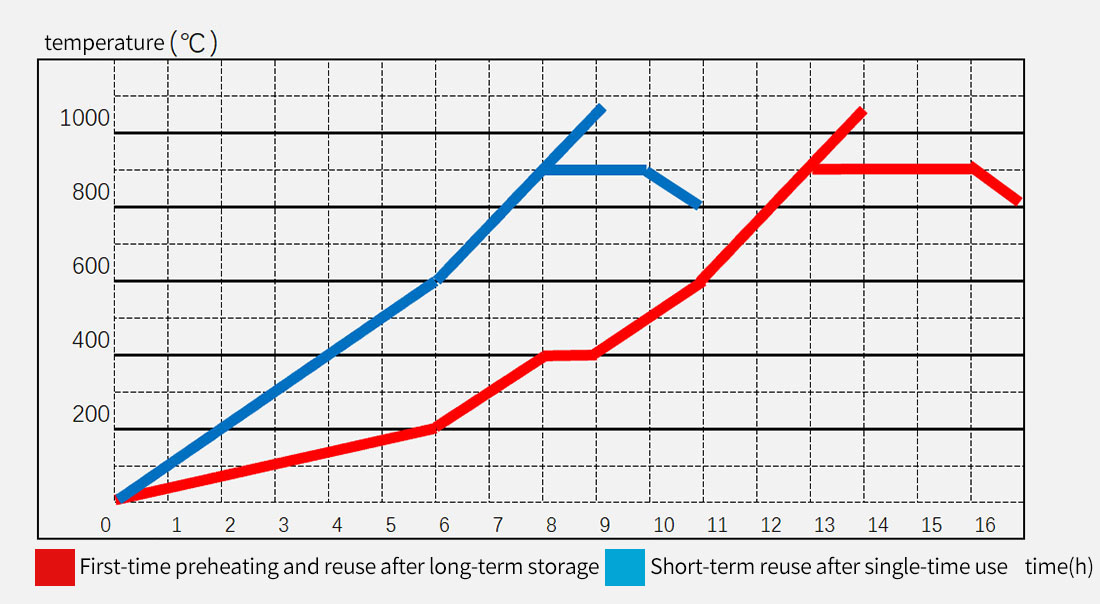
The crucible after installation in the furnace should be heated up slowly to a temperature of 200°C (392°F) to eliminate any moisture that may be present.
Due to the oversized dimension of the crucible, follow the specified preheating duration; appropriately extend or shorten the heating period based on seasonal ambient temperature fluctuations.
Next, adjust the temperature controller to gradually raise the crucible temperature to 400°C, hold at this temperature for 1 hour, then continue heating to 600°C, followed by continuous temperature rise up to 950°C.
Once the temperature hits 950°C, maintain the heat for 2 to 3 hours. This guarantees thorough fusion between the glaze coating and crucible substrate, maximizing the service life of the crucible.
All temperature readings shall be taken directly from the inner wall of the crucible to acquire its actual accurate temperature. The control system monitors furnace chamber temperature only, hence the preheating curve shall be governed by the crucible’s real inner temperature.
Note:
For holding crucibles this procedure should be carried out periodically, but always before starting up again after a cool down period. This helps to compensate for the negative effects of low holding temperatures.
Each time the crucible is heated up after a cooling down phase, it should be heated following the procedure laid down for the first installation. However, the drying time of 2 hours can be omitted. Should the Silicon Carbide or Clay Graphite crucible not be used for a long period, it will be necessary to eliminate moisture, which may have been absorbed from slag. In this case, the crucible should be heated up to a temperature of 200°C (392°F). After reaching this temperature, further heating should be continued as per the first installation.
The above recommendations refer to the use of new crucibles in existing furnaces. When installing a new Silicon Carbide crucible into a new furnace, the heating and drying instructions of the furnace manufacturer should be followed. If the furnace manufacturer prescribes a longer heating cycle (or curve), this procedure should be carried out without the crucible. It is essential that the crucible is installed in an absolutely dry furnace.
Suzhou GMG Advanced Materials Co., Ltd Hotline:400-668-3908
 Email:info@gmgam.com
 Address:Room 2303, Zhongxin Ecological Building, No.2 Keying Road, SIP, Suzhou
 Postal Code:215000

Technical Consulting
